In the face of the immediate energy challenges in Ukraine, this project is focused on advancing innovative cascade heat pump technology, which could revolutionise high-temperature heating and cooling solutions by significantly improving their efficiency, adaptability, and overall performance.
The technology, funded by InnovateUkraine, is specifically designed to operate efficiently under Ukraine’s climatic conditions and integrate with existing high-temperature radiator-based heating networks, making it highly suitable for deployment in both war-damaged and legacy buildings. Its two-stage cascade configuration, combined with a modular design and predictive control system, aims to overcome critical limitations in current heat pump technologies – most notably poor seasonal performance, inadequate temperature lift, and inflexible operation. As a result, the development and commercialisation of this technology offer a more robust and energy-secure alternative that aligns with Ukraine’s broader ambition to transition away from hydrocarbons.
Conventional heat pump systems are often constrained by poor seasonal performance, limited ability to deliver high supply temperatures, and the need for complex controls when switching between heating and cooling modes. These shortcomings are particularly problematic in Ukraine, where many buildings rely on high-temperature radiator-based systems that are not easily compatible with standard low-temperature heat pumps.
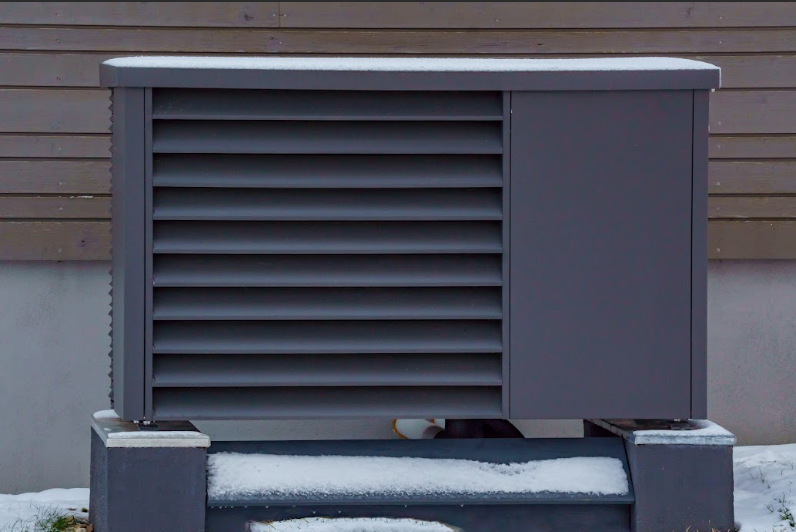
To address these challenges, Dual Heat Pumps is developing a two-stage cascade heat pump that combines a transcritical CO₂ cycle with vapour compression technology. The modular system is governed by a predictive smart control strategy, allowing it to operate reliably and efficiently across a wide range of environmental and load conditions including ambient temperatures as low as minus 20°C – far below the capabilities of most commercial systems and other heat pumps. It can also deliver water temperatures of up to 90°C.
Unlike traditional ground-source heat pumps, this system uses air as its source, simplifying installation and reducing cost. A smart controller will be embedded to manage real-time switching between modes, improving user comfort and significantly enhancing energy efficiency. This technology is particularly well-suited to Ukraine’s current context, as it enables rapid deployment in existing infrastructure, older fossil-fuel based buildings and new developments without requiring major retrofitting.
Key innovations include: [Design note: it would be great to include this following list as a visual box-out if the website design supports that, to help break up the body of text – please also remove highlighted text here]
As part of the InnovateUkraine programme, the Dual Heat Pumps team is developing digital simulation tools, finalising the modular system design, and installing a 150 kW prototype in Ukraine for live testing under real operating conditions. These outputs will provide critical data to validate the technology and accelerate its commercial readiness.
Over the past few months, the Dual Heat Pumps project has achieved major technical and operational milestones:
The immediate beneficiaries of this technology will be the people and residents of Ukraine, with more reliable heating, cooling and hot water supply available to a range of building types alongside reduced energy costs.
Industrial users are also engaging with the project, including partners requiring temperatures above 60 °C for process heat. By combining DHP units with existing systems, the consortium has demonstrated that output temperatures up to 120 °C are achievable, opening up new industrial and commercial applications.
By the end of the project, the Dual Heat Pumps team aim to have completed the installation and performance analysis of their pilot system, demonstrating the technology’s ability to deliver high-temperature heating efficiently, even in sub-zero conditions.
This demonstration will confirm both the technical performance and commercial potential of the technology, validating its readiness for wider deployment across Ukraine’s residential, industrial, and public sectors. The use cases being developed, including those with industrial partners, will provide verified data on cost and performance, strengthening the business case for scaling production.
Through the InnovateUkraine programme, the consortium will also have advanced development of its smart control system, integrating predictive functions for weather, occupancy, and renewable inputs to optimise operation. Together, these milestones will position DHP for commercial readiness and enable active engagement with investors and industry stakeholders in early 2026.
The partners expect to build on this foundation by expanding the technology’s application across Ukraine’s recovery efforts, supporting both reconstruction and decarbonisation. They will continue to refine the design for different system capacities, from 20 kW to 500 kW, allowing customisation for a wide range of buildings and infrastructure needs.
Longer-term, the project innovation offers a scalable, low-carbon heating and cooling solution that can enhance energy independence and reduce reliance on imported fossil fuels. By proving the system’s adaptability and economic viability in Ukraine, the team can unlock future investment and establish a platform for local manufacturing, training, and green job creation.
The approach also has potential across Europe – offering a model for other countries seeking resilient, high-efficiency heating systems for use in cold or energy-insecure environments.